You’ve got the new job. The offer’s signed, the LinkedIn post is up, and somewhere between packing your old desk and your first Monday meeting, the real pressure kicks in: everyone around you is waiting to see what you do first.
New HR role? Here's how to move the needle in your first few months

Whether you’ve joined as a CHRO, HR Business Partner, or HR Manager, that pressure feels the same: understand the organization fast, earn credibility with leadership, and figure out where to put your energy first.
The instinct is to start changing things immediately. But the most successful HR leaders actually do something different first: they listen.
Before you change anything, understand what’s really happening
Every organization comes with a story. Leadership has its version, managers have theirs, and employees often have another.
In your first few weeks, you’ll hear plenty of opinions about what’s working and what isn’t. The real challenge is separating perception from reality.
Problems rarely start when people notice them. By the time engagement drops, turnover rises, or productivity suffers, the underlying signals have usually been there for months: teams lose alignment, priorities blur, trust quietly erodes, and momentum slows, often long before any of it shows up in a report.
As a newcomer, you’re in a unique position: seeing the organization with fresh eyes, before its politics and habits become invisible to you too. The question is how you turn those early observations into something more reliable than instinct. One good way to start: before you launch anything new, make sure you can answer five specific questions.
Five questions every new HR leader should answer first
Before launching a new initiative or program, try to answer these questions:
- Do people trust leadership, and the direction the organization is heading in?
- Where are the biggest people risks emerging?
- Which teams are effective, and which aren’t?
- Can managers lead their teams effectively through constant change?
- Can our people actually execute the strategy?
Together, the answers tell you an enormous amount about whether the organization can actually execute its strategy. Not next year, but right now.
Why many HR leaders struggle to get those answers
The problem isn’t a lack of data. Most organizations already have engagement survey data, attrition reports, absence figures, performance metrics, and no shortage of PowerPoint decks. What’s missing is a current view. Annual surveys tell you how people felt months ago; attrition tells you who’s already left; absence data shows you where problems have already emerged. All of it useful, all of it backward-looking, and usually scattered across systems that don’t connect.
For someone trying to make an impact in a new role, backward-looking data isn’t good enough. You need to understand what’s happening right now, not what was happening last quarter.
This is where you can make a difference
Most organizations get stuck here: they treat employee listening (the surveys, the feedback, all of it) as a once-a-year event instead of an ongoing capability. The HR leaders who break that pattern build a steady, ongoing read on how employees and teams are doing, so they get signals early: where change is working, where managers need support, where trust is eroding, where high-performing teams are quietly struggling beneath the surface. That’s the difference between reacting to problems and getting ahead of them.
It also changes how leadership sees you. Instead of reporting on what happened last quarter, you’re bringing insight into what’s happening now and what leadership should be paying attention to next.
Why the timing actually works in your favor
AI adoption, new ways of working, talent shortages, economic pressure, shifting expectations — for most organizations, change isn’t an occasional event anymore. It’s the operating environment. Organizations operating in permanent transformation need live signals, not hindsight, because employees usually feel the effects of change long before any of it shows up in attrition or absence numbers.
For a new HR leader, that’s both the challenge and the opportunity. The challenge: everything is already moving fast. The opportunity: you get to build a different way of leading from day one; a continuous flow of insight into how the strategy is actually landing across the organization, instead of a yearly guess.
How Effectory helps new HR leaders get up to speed faster
At Effectory, we believe employee listening should function as a continuous organizational development system, one that helps leaders understand what’s happening inside the organization while change is still unfolding.
Instead of collecting feedback once a year and filing away the results, you can build a lightweight listening rhythm that gives you continuous insight into:
- Engagement
- Performance environment
- Leadership effectiveness
- Team effectiveness
- Change readiness
- Retention risk
- Organizational health
The result: a much clearer connection between people strategy and business outcomes.
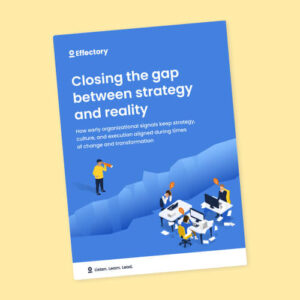
Closing the gap between strategy and reality
Download the guide and discover how to recognize early signals before KPIs, align culture and strategy, and bridge the gap between strategy and execution.
DownloadOur platform combines Smart Listening, 30 years of people science, AI-powered insights, benchmark intelligence, and expert guidance to help HR leaders move from measurement to actual improvement. For someone stepping into a new role, that means you don’t have to spend your first six months piecing together fragmented data and competing opinions. Instead, you can quickly build a clear picture of what’s working, where support is needed, and where your attention will have the greatest impact.
You’ll be able to:
- Build a reliable baseline of organizational health and team effectiveness within your first months, so you have a strong foundation for your first people decisions;
- Identify struggling teams and emerging people risks, and bring targeted recommendations to managers and leadership;
- Bring employee-backed insights into leadership discussions, rather than relying on assumptions or anecdotes;
- Give managers clear, actionable insights that helps them strengthen performance within their teams;
- Show the measurable impact of your initiatives within your first months.
Instead of spending your first year reacting to problems, you can focus on making informed decisions, supporting leaders with confidence, and building credibility as a strategic HR partner from day one.
Your first months set the tone
A new HR role creates a rare window of opportunity: colleagues expect fresh thinking, leaders are listening, and managers are looking for direction.
The temptation is to move fast and launch something new. The most effective HR leaders build visibility first instead.
Because when you can clearly see what’s happening inside the organization, you make better decisions. You support managers more effectively. You earn credibility faster. And you build a stronger foundation for every initiative that follows.
You don’t have to figure it all out alone
Book a short demo and discover how Effectory can help you build credibility faster, identify your biggest opportunities and risks, and create visible impact from day one.
Book a free demo. See our solutions in action.
Effectory is Europe's Leading provider of Employee Listening Solutions. Schedule a product demo and discover how to enhance your employees' engagement.
Demo request